SELF-AWARENESS
 Sujatha Bhaskar
WHAT IS SELF-AWARENESS?
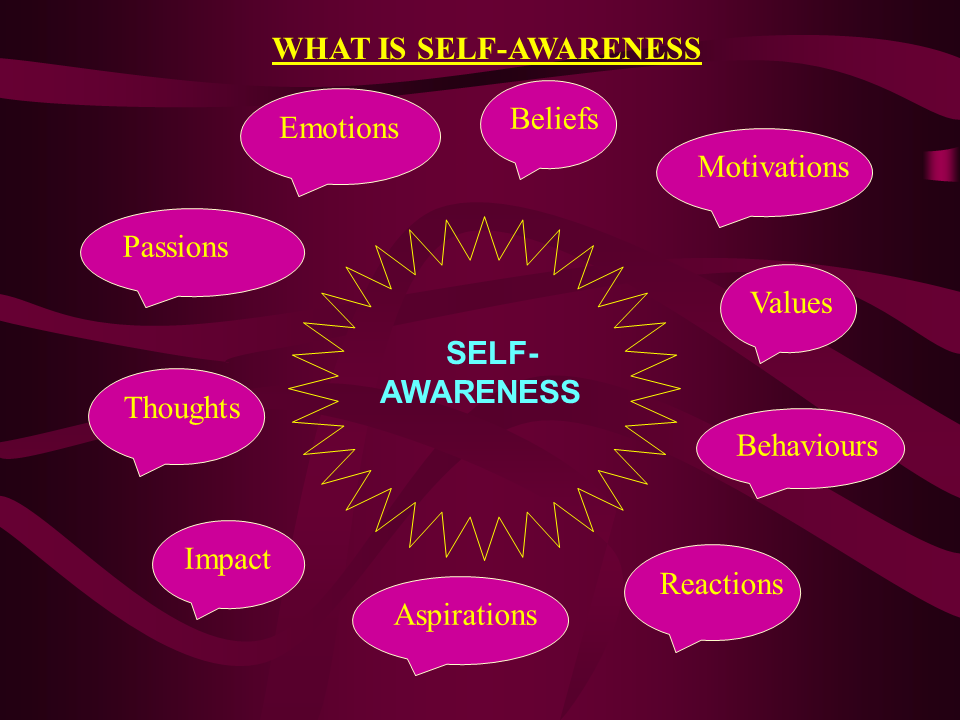
Self-awareness is a simple process of knowing about one's self. It means paying attention to what am I? What are my positive and negative traits? How do I understand my own psychological functioning? However, it is a very delicate conscious process as it calls for deeper introspection into one's mental processes. Self-awareness therefore means understanding of one’s physical, emotional, cognitive and psychological beliefs and motives. We try to evaluate ourselves in order to obtain a complete picture of self.
From a psychological perspective, self-awareness may be considered as the conscious ability of an individual in understanding his physical, emotional, mental, social and spiritual capabilities. It is the process of obtaining active knowledge about one's own internal states, including his thoughts, emotions, values, behaviours and motivations. Further, it involves understanding how these internal factors influence an individual and also how it reflects in his interactions with others in the given environment. It is like an internal mirror that helps to observe one's strengths, weaknesses and habits objectively. It acts as an essential component for emotional regulation, personal growth, decision making and social functioning.
KEY CONTRIBUTORS:
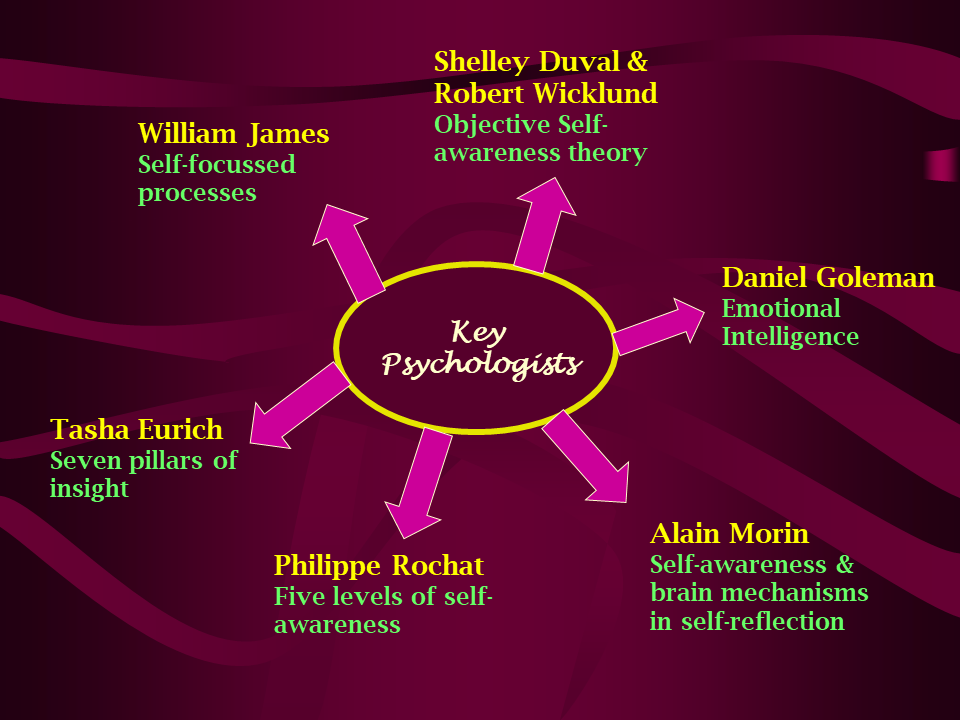
William James (1891)- An early contributor who explored self- focussed processes, self esteem and personal goals.
Shelley Duval & Robert Wicklund (1972) - Developed the Objective Self Awareness Theory, which proposes that at a given moment, people can focus attention on themselves and enable self-evaluation. In this process, they compare their current behaviour and thoughts to their internal standards and values, leading to objective self-awareness.
Tasha Eurich - Highlights on seven pillars of insight (self-awareness) - values, passions, aspirations, fit, patterns, reactions and impact that leads to high performance, smart choices and lasting relationships. She also distinguishes between internal self-awareness (Understanding one“s self values & emotions) and external self-awareness (Understanding how others perceive us).
Philippe Rochat - proposed five levels of self-awareness - Differentiation, situations, permanence, self-recognition and self-consciousness. Each of these levels develops through early childhood experiences and interactions.
Alain Morin - Contributes for research on self-awareness, self-consciousness and brain mechanisms involved in self-reflection.
Daniel Goleman - Popularised the concept of Emotional Intelligence and highlighted the significance of self - awareness within the framework of Emotional intelligence.
TYPES OF SELF-AWARENESS:
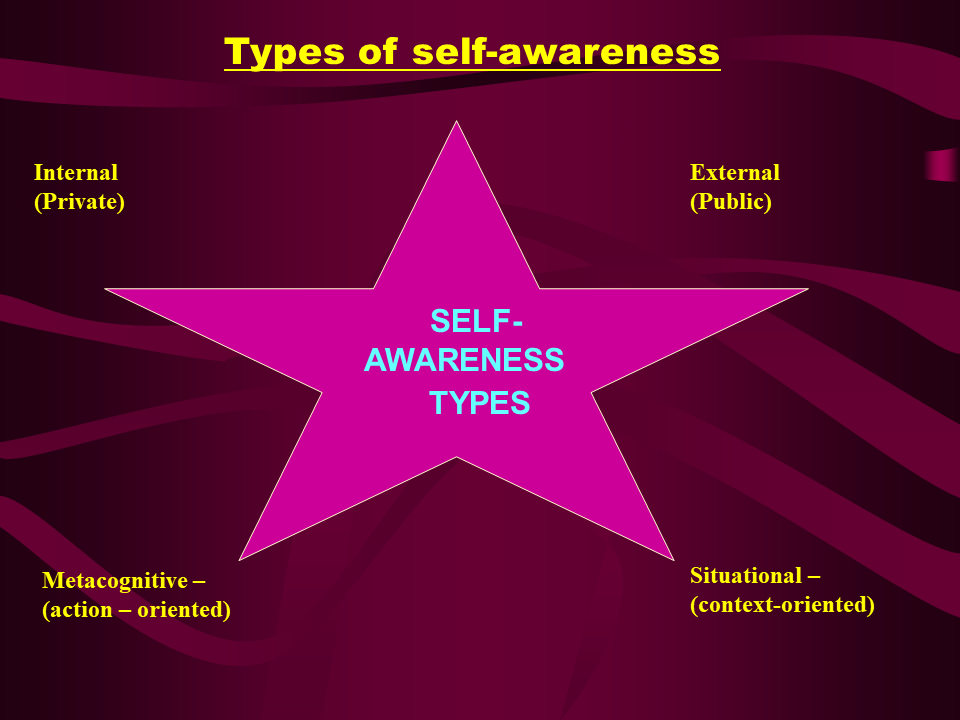
There are four types of Self-awareness. They are internal, external, metacognitive and situational self-awareness.
Internal self-awareness - This means recognising and understanding one's own emotions, thoughts, passions, aspirations and values. It is also known as private self-awareness as this is unique for each individual. It is the ability of a person to recognize one's own strengths and weaknesses. It helps in aligning one's actions with his core beliefs.
External self-awareness - This means understanding how one's emotions, thoughts and behaviours are perceived by others. This is also known as public self-awareness, as it examines how one's impact, presence and behavioural patterns are perceived by others. This is crucial in building better interpersonal as well as social relationships with others.
Metacognitive self-awareness - Metacognitive awareness means understanding and regulating one's own cognitive processes. This awareness enables a person to recognize his cognitive strengths and weaknesses. It enlightens three significant skills - planning, monitoring and evaluating. These skills can be applied in learning, comprehension, information processing, time management, strategic planning and problem solving scenarios. They play a key role in enabling a person to make better decisions.
Situational self-awareness - Situational self-awareness refers to the awareness of an individual’s emotions, thoughts and behaviours within a specific context. This awareness is the ability of a person to perceive, understand and predict a given environment with respect to time and space. This awareness is essential for personal safety, threat identification and proactive planning. Further,it helps an individual to adapt his behaviours to the demands of the specific moments.
All the above types are interrelated to each other as they play a vital role in encouraging an individual to develop an optimistic approach towards life challenges.
DIMENSIONS OF SELF-AWARENESS:
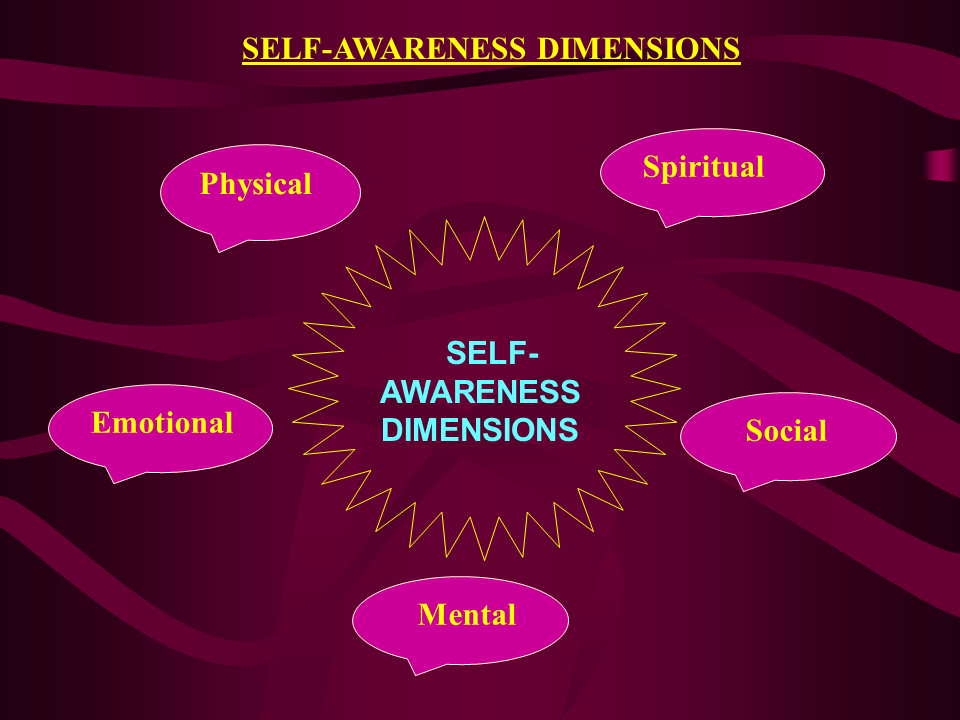
As self has five dimensions, developing awareness about self may also be discussed in relation to these dimensions. They are:
Physical self-awareness
Emotional self-awareness
Mental self-awareness
Social self-awareness
Spiritual self-awareness
1 Physical self-awareness- For everyone of us recognition of ourselves begins with awareness about our body. Bodily awareness is the primary awareness to any individual who is trying to understand his own existence. When someone enquires about us, we try to introduce ourselves with our name. This name is given to our body. This sex, age, at the primary level. These are indicators of our physical identity. Understanding our physical features, fitness level, stamina and strength play a significant role in enhancing one's physical self performance. One can obtain a healthy positive satisfaction in life by understanding self-expectation. This knowledge lays the foundation for dwelling into other dimensions of self-awareness.
2 Emotional self-awareness- Emotions play a major role in every individual's life. It is therefore very important for a person to obtain a global awareness about his emotions. Identifying and labeling the dominant emotions, noticing how they manifest in the body, and understanding the situations that trigger specific emotions are considered to be pivotal in emotional self-awareness. This awareness substantially helps in the management of rollercoasters of emotions. Exercising control over rapid, intense and unpredictable emotional feelings guides an individual towards a meaningful life.
3. Mental self-awareness- Mental self-awareness is nothing but recognizing and understanding one’s thoughts, feelings, emotions, motivations and beliefs. This is absolutely necessary for every individual to manage their actions and behaviour. How we react to stimuli in any given environment, depends upon various psychological factors like our personal beliefs, thoughts, feelings, motivations etc. Our reactions therefore vary from person to person for the same stimulus. However, understanding one’s mental activities and exercising control over them, helps an individual to handle his psychological demands and pressures less stressfully.
4. Social self-awareness- Social self- awareness means the ability of a person to empathize with others in the society. This is as important as mental self-awareness. In mental self- awareness a person is trying to obtain knowledge about his own mental activities, whereas in social self awareness, he is trying to understand the perspectives of others and also tries to accept and follow the social norms. Social self-awareness plays a key role in emotional intelligence. Understanding and objectively viewing the perspectives of others help for building stronger, more empathetic and harmonious interpersonal and social interactions. These are essential for socially healthy communications and for stronger social relationships.
5. Spiritual self-awareness- Spiritual awareness means developing an understanding about our core values and purpose. Further, it brings awareness about what brings peace to a person irrespective of external pressures. Hence, spiritual self-awareness is the conscious recognition of one’ s internal soul. This may be achieved by continuous self introspection and by objectively evaluating one's actions, motives and habits in relationship with a divine power. Further, shifting focus from the outer sensory world to the inner soul, accepting one‘s strengths and weaknesses without attaching too much self-importance, living in the present moment helps for obtaining higher principles and attaining the essential inner peace.
ADVANTAGES OF SELF - AWARENESS:
Self-awareness skills are crucial for any individual and they promote healthy lifestyles. Cultivating them in the right manner helps an individual to
Obtain better personal growth and development;
Exercise control over emotional reactions
Reduce impulsive actions and make stronger long-term decisions
Be proactive, attain better self- confidence and develop positive mindset
Enhance his communication skills and better relationship with others.
Develop better leadership skills
Acquire a healthy positive life perspective.
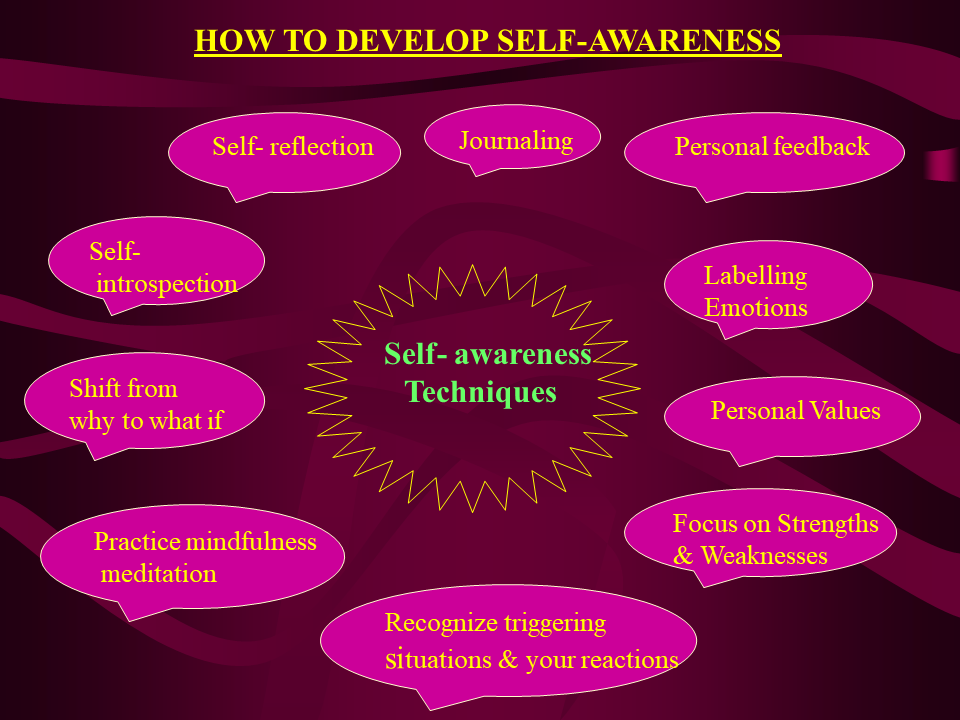
HOW TO DEVELOP SELF-AWARENESS?
Self-awareness may be developed in many ways. If you are keen on enhancing your self-awareness level, then you have to regularly practice some of the techniques mentioned below.
Self introspection - learn to observe yourself objectively or look into your internal self in depth.
Self-reflection - consciously analyse your thoughts, emotions, behaviours and motivations
Journaling - Write down your daily experiences, thoughts and feelings. This assists you to review your reactions.
Personal feedback - obtaining constructive, personalized, timely and actionable feedback on your behaviours helps to uncover blind spots.
Labelling Emotions - identifying and naming specific emotions as they arise, is useful in regulating one's emotions.
Personal values - identifying and labelling personal values helps for building internal standards.
Focus on weaknesses and strengths - understanding one’s strengths and accepting weaknesses navigate better success in personal and professional life.
Triggering situations and reactions - Recognising triggering situations and evaluating your reactions in such situations may guide you towards healthy interactions.
Shift from Why to What - Changing all your why questions to what if… may help you to observe your over thinking and guide you to identify blind spots in your interactions.
Practice mindfulness meditation - Objectively observing self without any judgement, may help you to develop better internal strengths.
HIGHLIGHTS/ TAKEAWAY:
Self-awareness is a simple process of knowing and understanding about one’s physical, emotional, cognitive and psychological beliefs and motives.
There are four types of Self-awareness. They are Internal (private), external (public), metacognitive (action -oriented) and situational (context-oriented).
Self - awareness has many dimensions. They are - Physical, Emotional, Mental, Social and Spiritual self-awareness.
Self-awareness skills are crucial for any individual and they promote healthy lifestyles.
Self-awareness may be developed in many ways. Some useful techniques are, introspection, reflection, journaling, focusing on strengths and weaknesses, obtaining self feedback, taking a stack of personal values and emotions, regulating your reactions to triggering situations and mindfulness meditation.